Ford started building cars in Canada over a century ago after a Detroit factory and a Windsor carriage company formed a partnership that transformed North American auto production. The 1904 agreement created Ford Motor Company of Canada, marking the first time a U.S. automaker had produced vehicles outside its home country. Henry Ford viewed Canada as a strategic route to avoid tariffs while expanding into Commonwealth markets, while Gordon McGregor’s wagon business gained access to the Model C—a vehicle that would soon reach South Africa, Australia, and New Zealand.
Canada’s auto sector did not originate with Ford. By the late 1800s, domestic brands such as Tudhope and McKay manufactured wagons and early automobiles, but they faded as American companies expanded. The 1879 tariffs had already shielded Canadian factories from U.S. competition, though they also restricted cheaper imports, forcing local producers to innovate. When Ford entered the market, it introduced not just vehicles but a production system that would dominate the continent.
The first Canadian-assembled Ford left the production line in 1904, but the industry’s foundations stretched back further. In 1867—the same year Canada became a nation—Robert McLaughlin established the McLaughlin Carriage Company in Oshawa, Ontario. His son, Sam, recognized the future in automobiles. By 1907, McLaughlin was licensing Buick assembly, using engines from General Motors, which Billy Durant had assembled by acquiring struggling automakers. The partnership proved so successful that GM later took full ownership, renaming the operation General Motors of Canada in 1918.
GM’s Canadian operations became a major force. Factories in Oshawa, St. Catharines, and Sainte-Thérèse, Quebec, produced millions of vehicles, including the Chevrolet Camaro and Pontiac Firebird. The Oshawa plant has manufactured pickup trucks since the 1970s, while St. Catharines now builds V8 engines. However, not all GM ventures endured. A joint venture with Suzuki in Ingersoll, Ontario, shut down in 2025 after producing the electric Chevrolet BrightDrop van, a project abandoned when delivery van demand collapsed.
Chrysler entered Canada even earlier. In 1921, Walter Chrysler was hired to revive Maxwell, a Detroit automaker with a Windsor factory. He restructured the company and rebranded it under his own name in 1924. The Windsor plant became Chrysler Canada, and within years, it was producing Dodges, Plymouths, and DeSotos, brands that later disappeared in the U.S. but kept Canadian production alive for decades.
Japanese automakers reshape Canada’s car market
By the 1960s, Canada’s auto industry blended American dominance with a few independent players. Studebaker, once a major U.S. brand, relocated its entire operation to Hamilton, Ontario, in 1963 to qualify for duty-free imports.
Japanese automakers arrived later but reshaped the market. Before 1973, American drivers favored large, powerful cars, but the OPEC oil embargo forced a shift toward smaller, fuel-efficient Japanese models. Honda and Toyota, which had sold motorcycles and parts in the U.S. for years, began local production. Canada followed the U.S. approach by negotiating voluntary export limits with Japan, though only Honda and Toyota established factories north of the border.
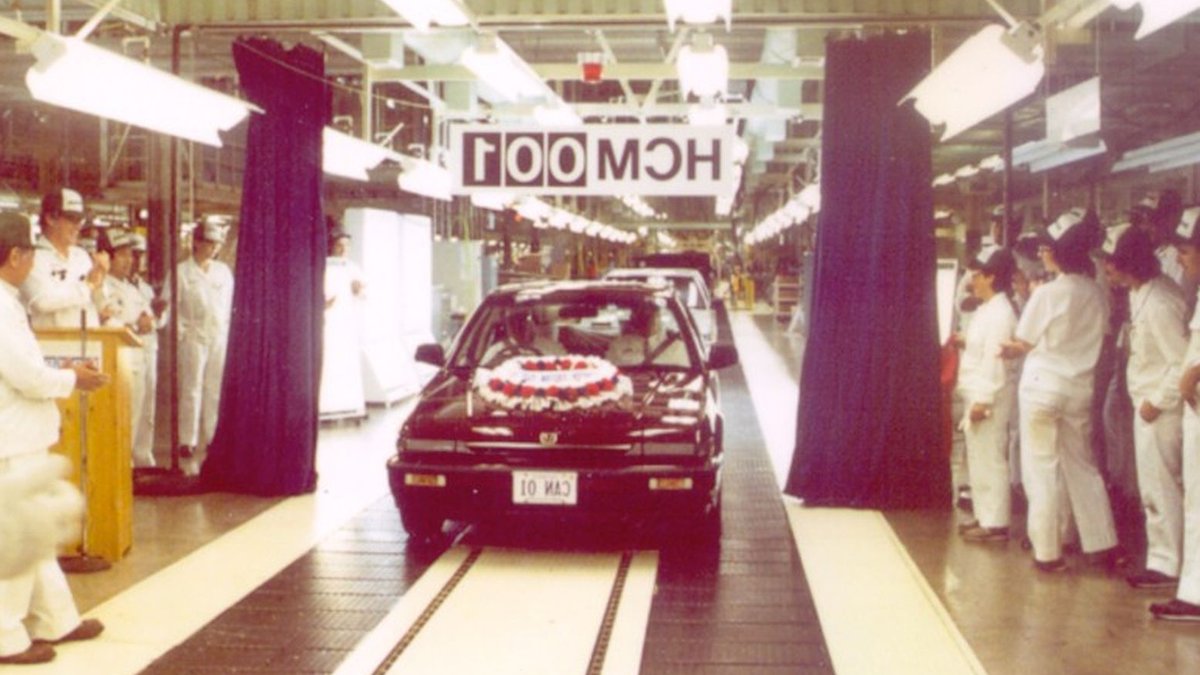
Honda’s first Canadian plant in Alliston, Ontario, opened in 1986, produced its first Accord, the first Japanese car made in North America outside Japan. Toyota followed in 1988 with a plant in Cambridge, Ontario, assembling Corollas. Both companies expanded rapidly. Toyota’s Cambridge complex now includes three plants, while Honda’s Alliston site added a second factory in 1998 and an engine plant in 2008.
Neither company’s Canadian operations have been without challenges. Meanwhile, Toyota is expanding its Toronto headquarters and adding parts distribution centers in Calgary and Surrey, British Columbia, signaling a long-term commitment.
Stellantis keeps legacy plants running
Stellantis, formed in 2021 by merging Fiat Chrysler Automobiles and PSA Group, now operates two major Canadian plants under its Chrysler and Dodge brands. The Windsor Assembly complex, active since the 1920s, remains central to the company’s North American production. It currently assembles the Chrysler Pacifica minivan and both gas and electric versions of the Dodge Charger, with electric models using batteries from a joint venture plant in Windsor. The facility also supplies parts for other Stellantis vehicles, including the Jeep Grand Cherokee, though Jeep production itself moved to Belvidere, Illinois, in 2021.
Stellantis’ other Canadian plant, in Brampton, Ontario, was originally constructed by American Motors Corporation (AMC) in 1986 to produce Jeep Cherokees after Chrysler acquired AMC in 1987. The site later expanded to include the Dodge Charger and Chrysler 300, with production ending in 2023. Unlike Windsor, Brampton’s future is uncertain, as Stellantis has not announced plans to restart assembly there. The closure ends an era for Brampton, which had been a vital part of Canadian auto manufacturing since the 1960s when AMC relocated from Toronto.
European and Korean brands fade in Canada
Canada’s auto history also includes short-lived ventures from European and Korean brands. Volvo established its first North American factory in Dartmouth, Nova Scotia, in 1963, assembling knock-down kits for models like the 120 Amazon series, later rebranded as the Volvo Canadian. The Halifax plant, opened in 1965, produced Volvo sedans until 1998, when the last S70 rolled off the line. The shutdown reflected global production shifts, as Volvo consolidated manufacturing in Belgium and the U.S.
Hyundai began Canadian production in 1989 with a plant in Bromont, Quebec, assembling the Sonata. The facility closed in 1993 after struggling with sales, a pattern repeated when Hyundai later exited European markets. Unlike its U.S. operations, which started in 2005, Hyundai has not returned to Canada, leaving Bromont’s former workers and suppliers without a major automaker presence. The plant’s closure also marked the end of Renault and Peugeot’s brief Canadian assembly venture through SOMA, a partnership that produced fewer than 60,000 vehicles between 1965 and 1974.
Canada’s Auto Industry: Historical Production and Defunct Brands
Canada’s automobile manufacturing history includes brands that no longer exist. Early producers like Tudhope and McKay made wagons and early cars before disappearing as American companies took over. Studebaker, originally a wagon maker, began producing cars in Walkerville, Ontario, in 1910 and later moved its entire operation to Hamilton in 1963. After financial struggles, Studebaker built its last Canadian car, a 1966 model, in Hamilton before shutting down.


