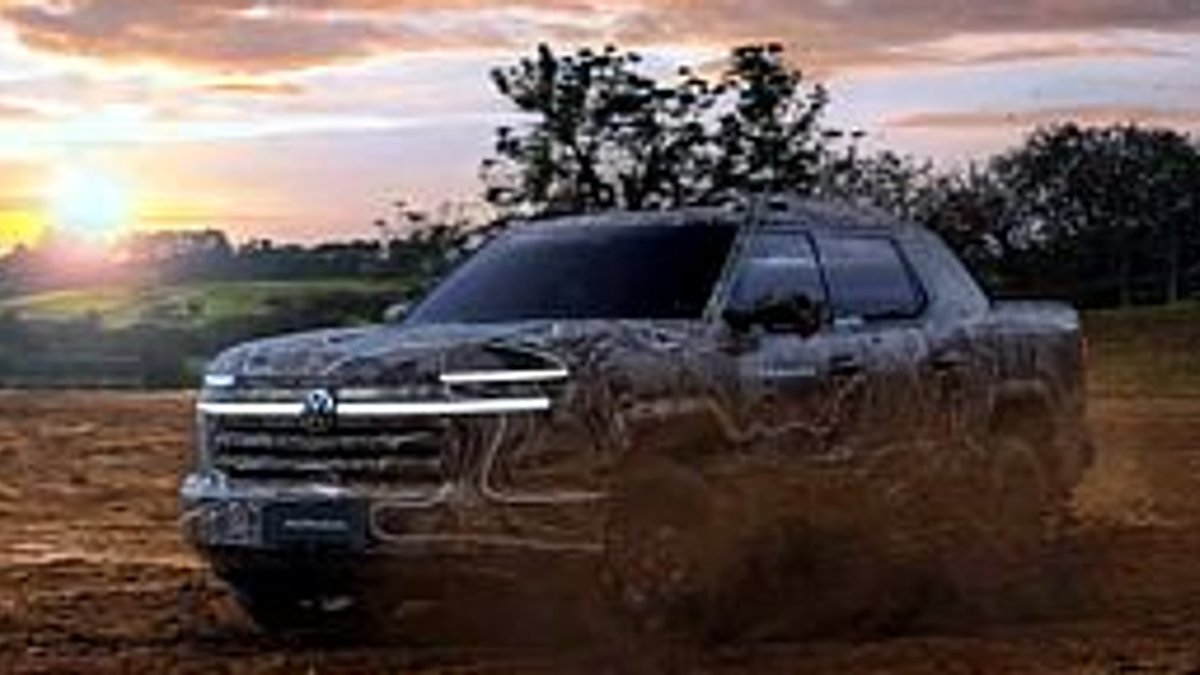
Volkswagen’s upcoming Amarok will focus on meeting Australia’s needs for heavy-duty towing and payload, with a 3,500kg braked towing capacity and a one-tonne payload as key targets. Volkswagen Commercial Vehicles (VWCV) strategy head Markus Wilke emphasized these figures as non-negotiable, stating, “3.5 tonne towing—that’s an absolute must,” while also stressing that cabin space and the one-tonne payload would remain consistent across variants. The third-generation ute will feature diesel, plug-in hybrid (PHEV), and battery electric (BEV) powertrain options, though exact details remain undisclosed. These specifications are fixed, especially for Australia, which plays a major role in shaping the vehicle’s design.
The powertrain lineup will include BEV and PHEV models alongside a V6 diesel or high-performance inline-four, ensuring the Amarok meets both commercial and performance demands. However, not every variant will deliver the maximum towing and payload figures, reflecting a broader industry trend where electrified models often compromise capacity for efficiency gains. This shift is particularly evident in Australia’s fragmented ute market, where some manufacturers have prioritized lower emissions over traditional workhorse capabilities, such as the GWM Cannon Alpha PHEV, which offers 3,500kg towing but only 685kg of payload.
Toyota’s new HiLux BEV achieves a 2,000kg towing rating but only a 725kg payload, while its diesel model retains 3,500kg towing. Ford’s Ranger PHEV maintains 3,500kg towing but offers 973kg payload in its top trim, demonstrating how PHEVs can balance performance and efficiency. The updated BYD Shark now matches the 3,500kg towing benchmark but still carries just 725kg payload. A BEV Amarok may prioritize fleet buyers with reduced capacity, while the V6 diesel would serve heavy-duty customers, ensuring Volkswagen retains its core market segments.
Volkswagen has not revealed battery specifications, range, or towing limits for the BEV Amarok, though a cancelled Ranger-based BEV prototype reportedly exceeded 500km range. Unlike Nissan, which imports a separate Chinese-built Navara Pro PHEV, Volkswagen plans a unified ute platform supporting all powertrains, avoiding the complexity of multiple models. This strategy aligns with Australia’s New Vehicle Efficiency Standard (NVES), which tightens emissions limits from 180g/km in 2026 to 110g/km by 2029. Adding PHEV and BEV variants helps meet these standards while still accommodating a higher-emitting V6 diesel, ensuring compliance without sacrificing traditional performance.
VWCV CEO Stefan Mecha described the flexible drivetrain approach as critical for staying competitive, noting that the current Amarok, produced in South Africa, will remain in production until 2029–2030 before being replaced. With global annual sales ranging between 30,000–40,000 units, Volkswagen lacks the scale for an in-house platform, forcing a partnership with another manufacturer. Ford, which supplies the T6.2 platform for the existing Amarok, remains the front-runner, though Chinese partners and alternative sourcing options are under consideration. The decision on platform sourcing may also influence Volkswagen’s future plans for an Amarok-based SUV, which remains in development.


