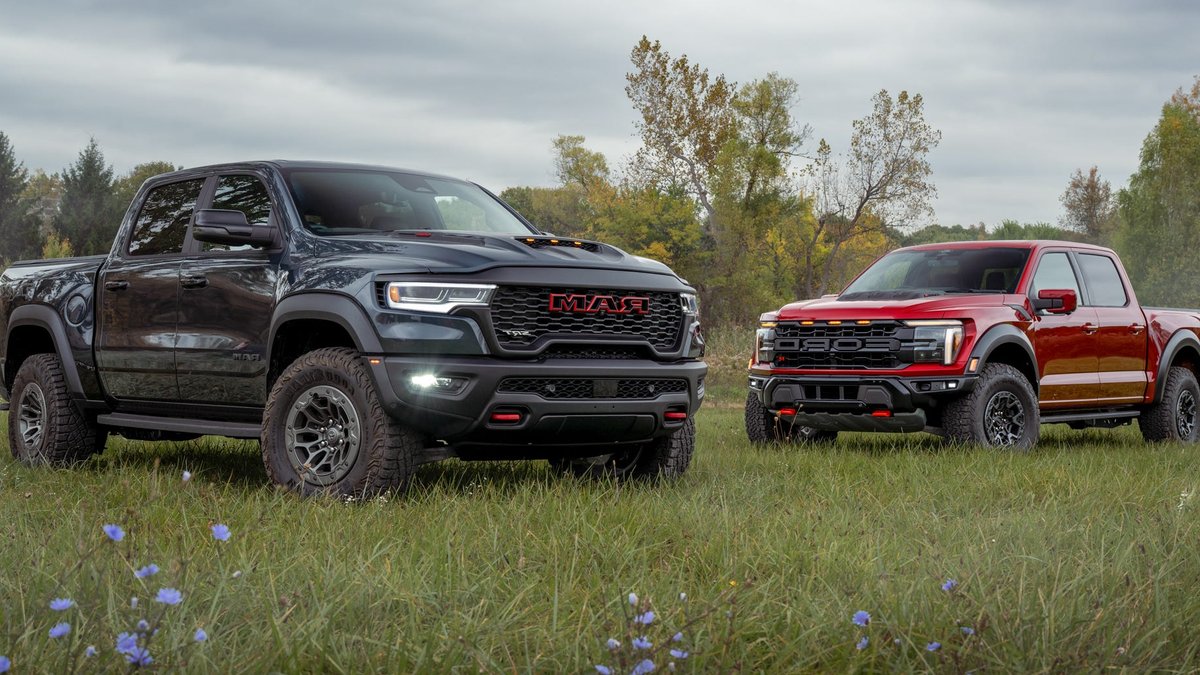
Ford has made significant revisions to its 2026 F-150 Raptor R, boosting its horsepower to 720 by revising the air intake path and recalibrating the spark and fuel curves, while retaining its torque at 640 lb-ft. The suspension has also been upgraded to Fox Dual Live Valve Shocks, which now offer independent variability to the rebound rate, enhancing its off-road capabilities. The Raptor R continues to wear 37-inch BFGoodrich tires with 10-inch sidewalls and a load-range C rating, providing superior compliance compared to the 2027 Ram 1500 TRX‘s 35-inch Goodyear Wranglers with 8.3-inch sidewalls and a load-range D rating.
The Raptor R features a redesigned front grille adorned with a Code Orange “R” badge, C-clamp LED lighting, and a modular steel bumper with winch mounting points and removable end caps that improve the approach angle. Inside, it includes a head-up display with amber indicators for lane departure, digital instruments, but lacks BlueCruise, a feature available in the Ram TRX as Active Drive Assist.
Styling and Interior Impressions
The TRX is favored for its broad-shouldered styling, while the Raptor R is seen as trying too hard to appear rugged. Inside, the TRX offers a more luxurious cockpit with ritzier trim and supportive seats. Its fun-loving design includes a drive mode selector marked with a speed-leaned font and a checkered flag graphic, alongside a dragstrip timing tree button. The TRX also features Performance Pages that display interesting stats, some of which can be saved for sharing on social media. In contrast, the Raptor R has a more business-like infotainment system and a boring rotary drive mode switch ringed by buttons for 2H, 4H, 4L.
Read Also: Subaru adds hybrid power to rugged Forester
Performance and Sound
The TRX produces a soprano supercharger whine, which, despite intake revisions, remains dominant. Those with acute hearing may detect a lovelier underlying basso exhaust note from its pushrod V-8, but it’s overshadowed. In contrast, the Raptor R’s sound engineering team has tamped down its supercharger whine and reduced the typical fourth-order V-8 burble, resulting in a high-strung racing engine howl preferred by judges. To restore the V-8 burble, an aftermarket exhaust with an H- or X-pipe can be installed to comingle the pulses from each bank.
On the test track, the TRX achieved a 0-60 mph time of 3.8 seconds and a quarter-mile time of 12.3 seconds at 111.7 mph, slightly behind the Raptor R’s 3.6 seconds and 12.1 seconds at 112.1 mph. The Raptor R’s transmission with two extra ratios and more expert shift programming enhances its responsiveness. The TRX’s optional cast-aluminum beadlock rims, nearly 10 pounds heavier per corner than the Raptor R’s forged wheels, and beefier axles and knuckles contribute to its 885-pound weight penalty, affecting handling on hilly and twisty roads.
Handling and Braking
Both trucks stop from 60 mph in 131 feet, but the TRX has a slightly higher lateral cornering grip of 0.71 g compared to the Raptor R’s 0.70 g. However, the Raptor R completes a figure-eight course 0.2 seconds quicker. The TRX’s Performance Pages provide peripheral vision cues during hot laps, and saved runs can be replayed for bragging rights. The Raptor R’s superior handling trends make it easier to place in curves, with sharper body motion control and less chassis shake after bumps, though the TRX’s steering wheel feels better in hand and its tires squeal less at their slightly higher limits.


