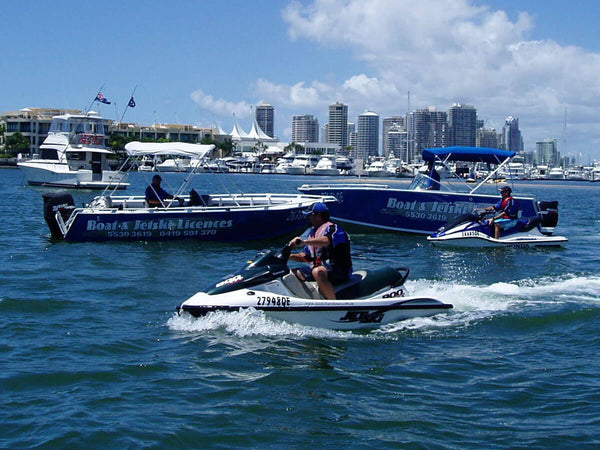
The Gold Coast is one of the best places in Australia to get out on the water. With the Broadwater, canals, rivers and coastline right on your doorstep, a boat or jetski opens up a whole new way to explore. But before you can take the helm of a powered recreational vessel in Queensland, you need the right licence.
If you have booked a course, or you are thinking about it, you might be wondering what the day actually involves. Here is a guide to what typically happens, from arrival to getting your licence.
Which licence do you need?
In Queensland, you generally need a Recreational Marine Driver Licence to operate a recreational boat with a motor above a certain power. To ride a personal watercraft, more commonly called a jetski, you need a Personal Watercraft Licence, and you must also hold, or obtain at the same time, a boat licence.
Many people choose to do both licences together, which can save time and give them the freedom to operate either type of vessel.
Licence training in Queensland is delivered through accredited training providers. Once you successfully complete your course, you take your paperwork to a Department of Transport and Main Roads customer service centre to have the licence issued.
Before the day
Preparation helps the day run smoothly. Before your course:
- Check your booking confirmation for the start time and meeting location
- Confirm what identification you need to bring
- Check whether you need to complete any online learning or pre-reading
- Ask what to wear, as you may get wet during the practical session
- Make sure you meet the age requirements for the licence you are doing
It is also worth reading through Queensland’s boating safety information. Even a quick look at the basic rules will help the theory session make more sense.
Arrival and introductions
On the day, you will usually start by checking in with your instructor and completing paperwork. Your identification will be checked and you will be given an outline of the day.
Course groups often include a mix of people, from first-time boaters to experienced skippers who have never formally held a licence. Instructors are used to teaching all levels, so there is no need to worry if you have never driven a boat before.
The theory session
The first part of the course usually covers the theory you need to operate a vessel safely and legally. Topics commonly include:
- Rules of the waterway, such as who gives way and how to pass other vessels
- Navigation markers, including what different coloured buoys and beacons mean
- Speed limits and distance rules, including how far to keep from swimmers, other boats and the shore
- Safety equipment, such as life jackets, flares, fire extinguishers and what must be carried on board
- Weather and tides, and how they affect safe boating
- Alcohol and drug limits for operating a vessel
- What to do in an emergency, including man overboard and breakdowns
- Environmental responsibilities, such as protecting marine life and avoiding sensitive areas
Instructors often use local examples, which is especially helpful on the Gold Coast, where waterways can be busy and conditions change with the tide.
The theory assessment
After the theory session, you will usually complete an assessment to show you understand the material. Instructors generally make sure everyone is well prepared before the test, and they will go over any areas you are unsure of.
The practical session
The practical part of the course is where you get behind the wheel. With your instructor on board, you will learn and demonstrate skills such as:
- Pre-departure checks
- Starting and stopping the engine safely
- Steering and controlling speed
- Turning and manoeuvring at low speed
- Docking and leaving a mooring or jetty
- Following navigation markers
- Responding to a person overboard situation
If you are completing a jetski licence, you will also learn skills specific to personal watercraft, including how to handle the craft, how to reboard from the water and how to operate safely around others.
Your instructor will guide you through each skill and give you feedback, so it is a learning experience as well as an assessment.
Finishing the course
Once you have completed the theory and practical components, your instructor will finalise your paperwork. You will usually receive documentation showing you have successfully completed the course.
You then take this, along with your identification, to a Department of Transport and Main Roads customer service centre within the required timeframe to pay the licence fee and have your licence issued.
Tips for the day
- Get a good night’s sleep and arrive on time
- Bring a hat, sunscreen, sunglasses and water
- Wear comfortable clothes and shoes suitable for getting wet
- Bring any glasses or contact lenses you need for driving
- Ask questions, as instructors are there to help
- Relax and enjoy it, because this is the start of your time on the water
Booking your course
If you are ready to get your licence, choose a provider that is accredited, runs regular course dates and has experienced instructors who know local waterways. Booking a course for Boat and Jetski Licences Gold Coast residents and visitors complete is a practical way to get both licences sorted in one go.
Getting out on the water
Your licence course day is the first step towards exploring the Gold Coast from a whole new perspective. With the right training, you will have the knowledge and confidence to enjoy the water safely, whether you are heading out for a day of fishing, cruising the Broadwater or riding a jetski with friends.


