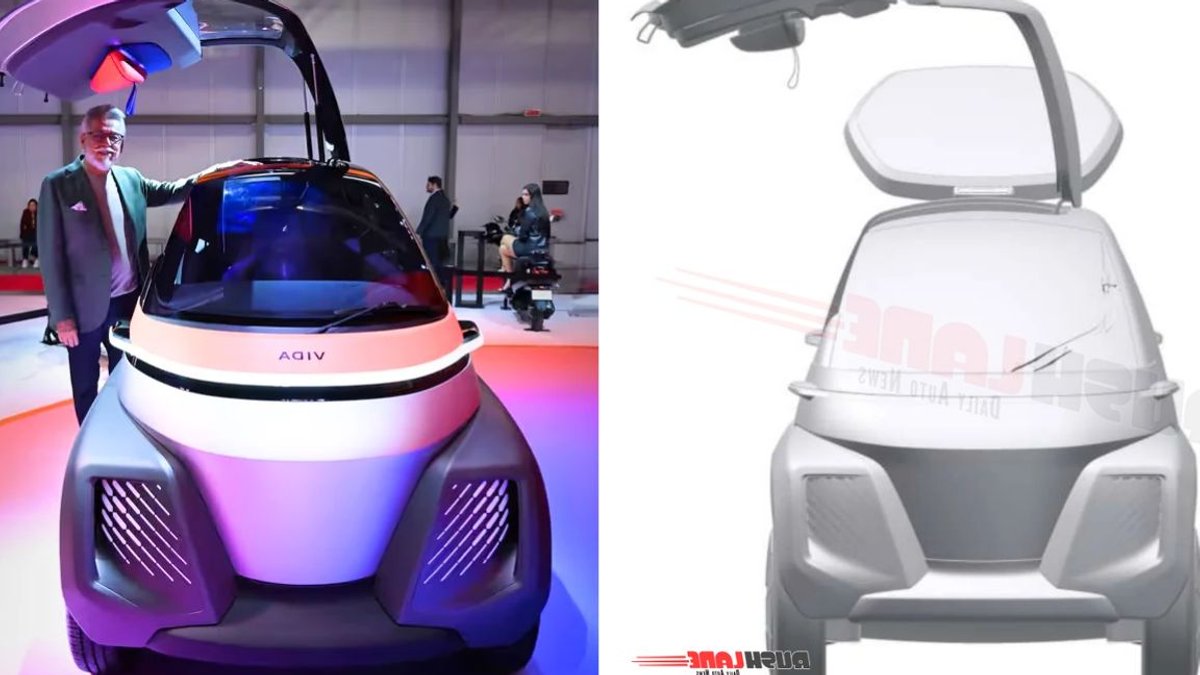
Hero Vida’s NEX 3 has secured a design patent in India for its ultra-compact electric vehicle, which merges automotive functionality with the agility of a two-wheeler. This follows the company’s earlier patent for the NEX 2, a self-balancing three-wheeler trike, expanding its electric mobility portfolio beyond traditional scooters and motorcycles.
The NEX 3 introduces a gullwing-style door that opens upward, solving common urban parking constraints. By eliminating the need for lateral space when parked, the design accommodates tight city environments while its large dimensions simplify passenger access. Once deployed, the door also provides the driver with unobstructed visibility, addressing concerns about confined cabin space in such a compact form factor.
The vehicle’s exterior reinforces its positioning as a micro SUV. At the front, a V-shaped grille is flanked by vertically aligned trapezoidal lighting clusters. A full-width LED strip runs across the hood, complementing aero-optimized alloy wheels fitted with low-profile tires. The rear showcases a hexagonal boot lid and a substantial bumper, while the sloping roofline maintains a low, streamlined silhouette.
Inside, the NEX 3 emphasizes simplicity with a hexagonal steering wheel and a minimalist dashboard featuring dual circular instrument gauges. Seating is configured for two occupants, with customizable interior trims allowing for personalization. While exact technical details remain undisclosed, the model is anticipated to include automatic climate control and turn-by-turn navigation, aligning with the needs of urban commuters.
The NEX 3 aims to serve a specialized market: buyers seeking car-like interior space but preferring the maneuverability of a two-wheeler. Its compact dimensions and electric powertrain respond to rising demand for low-emission, congestion-mitigating urban transportation. Though Hero Vida has not revealed a launch date, the design patent indicates ongoing development.


