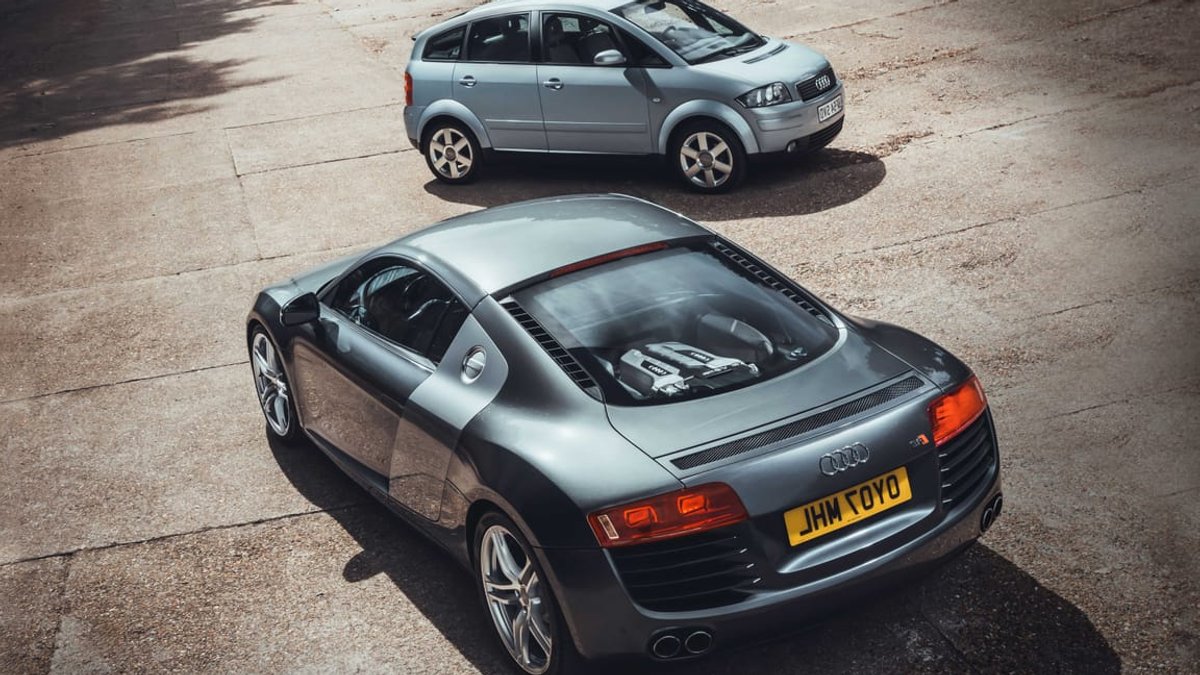
The Audi A2 and Audi R8 represented opposite ends of the automotive spectrum—one a compact, fuel-efficient hatchback, the other a mid-engined supercar. Both reflected Audi’s confidence and innovation during its Eighties/Nineties/Noughties pomp. That boldness, however, contributed to their challenges.
The R8: A supercar designed for real life
The R8 arrived in 2006 with a naturally aspirated V8 and a manual transmission. Its design was unmistakably aggressive—low, wide, and purposeful—and its performance matched, with a redline at 8,000 rpm and handling that balanced precision with forgiveness.
Unlike the intimidating supercars of its time, the R8 was accessible. The cockpit wrapped around the driver, creating a sense of connection rather than detachment. The body was rigid, the suspension finely calibrated, and the traction control allowed even less experienced drivers to push limits safely. It was built for daily use, not just occasional thrills.
Later models introduced a V10 and a Spyder variant, though the original appeal remained intact. Audi’s reputation for build quality ensured the R8 felt durable, with a cabin finished in premium materials. Yet despite its strengths, sales never matched its engineering excellence.
Related: Money Off New EVs: The Electric Car Grant Guide
The issue lay in expectations. Supercars are meant to be impractical, demanding, and exclusive. The R8, however, was almost too practical. It lacked the drama and exclusivity that buyers in that segment often sought. After two generations, Audi ended production without fanfare.
The A2: Innovation without demand
The A2 debuted in 1999 as a fiercely rational car, built on a mission to deliver maximum space with minimal fuel consumption. Its aluminum construction kept weight under 900 kg in the main petrol version, a feat at the time.
That lightweight design, paired with a sleek aerodynamic shape, made it one of the most fuel-efficient cars of its era. It comfortably seated four adults, offered a practical boot, and had doors that closed with the solidity of a larger vehicle. Surprisingly, it was also enjoyable to drive—nimble and precise, avoiding the vague feel of some of Audi’s other small models.
Yet the A2’s strengths became its weaknesses. Priced like a premium car—nearly double the cost of most superminis—it looked like one too. Buyers seeking space and practicality chose the A3, which had a more conventional design and stronger brand appeal. The A2’s focus on efficiency didn’t align with a market unprepared to pay extra for fuel savings.
When the A2 launched, fuel prices were still low, and the idea of a small, expensive car prioritizing CO2 reduction over desirability struggled to gain traction. It required explanation, and most buyers didn’t want to defend their choice to skeptical observers.
Related: VW revamp centers on core brands
Both models suffered from being too advanced for their markets. The R8 was a supercar that didn’t behave like one, while the A2 was a small car that defied its category. They were exceptional but demanded buyers value engineering over instinct.
In an industry where emotional decisions often outweigh logic, that was a difficult sell. The A2’s failure was clear, but the R8’s quiet discontinuation suggests even a car with performance, usability, and quality couldn’t overcome preferences for something less refined.
Time has been more forgiving. The A2 is now a cult favorite, celebrated for its visionary design and craftsmanship. The R8, too, has become a modern classic, a symbol of Audi’s willingness to take risks. Both proved that innovation doesn’t always succeed commercially but can leave a lasting impact.
A similar shift occurred when a Chinese SUV undercut established luxury brands by thousands, challenging expectations in a different segment.


