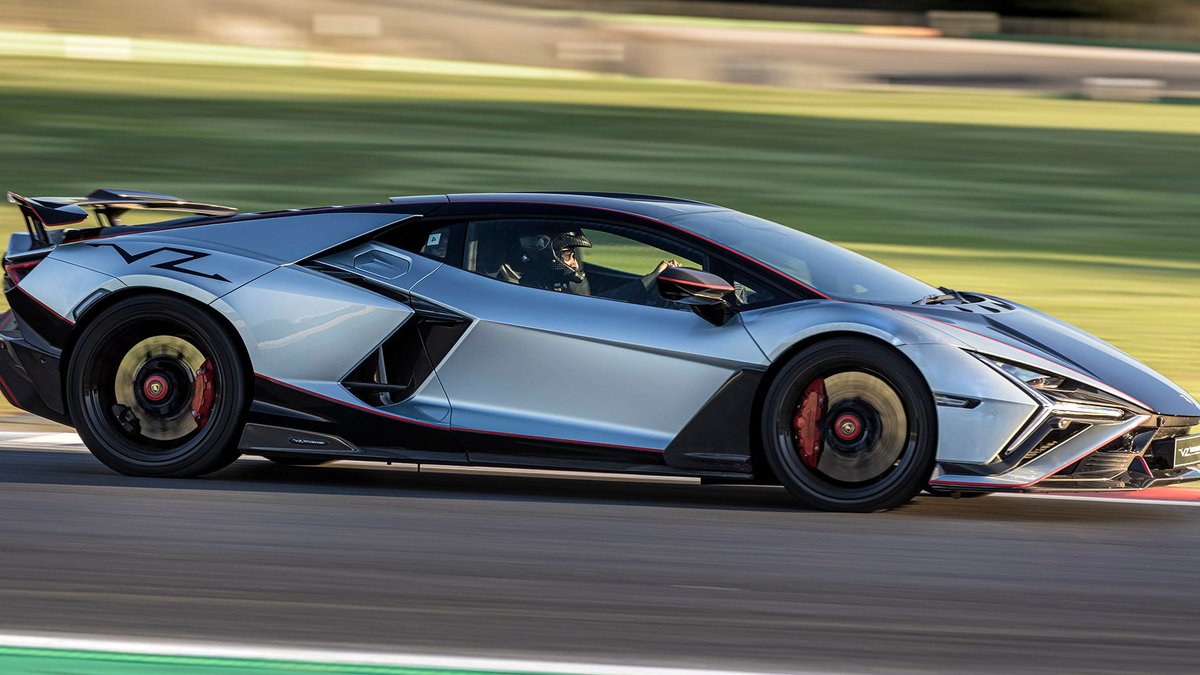
A first drive of the 2027 Lamborghini Revuelto SV at Italy’s Vallelunga test track showcased a vehicle that blends precision with controlled aggression, abandoning the chaotic oversteer of earlier V-12 Lamborghinis. The SV’s handling now feels predictable, allowing drivers to anticipate tire limits before the rear wheels break loose. Bridgestone’s new Potenza Race R semi-slick tires, 345/30 R21 at the rear and 265/35 R20 front, offer grip akin to glue, while the all-wheel-drive system and front-motor torque vectoring prevent spin even under aggressive inputs. The car’s 3,907-pound dry weight, just 11 pounds lighter than the standard Revuelto, does not hinder its agility, thanks to aerodynamic refinements that boost downforce by 80% compared to the base model.
Lamborghini’s Bosch 6D sensor and Integrated Power Brake (IPB) system work in tandem to anticipate tire grip during braking and acceleration, eliminating abrupt ABS feedback. The Brembo-developed CCM-R Plus carbon-ceramic brakes, 16.5 inches front and 16.1 inches rear, feature a silicon-carbide surface layer for superior heat distribution, reducing hot spots and maintaining performance through repeated hard stops.
The hybrid powertrain delivers explosive acceleration but comes with a key limitation: the battery depletes after just three laps at full power, requiring a shift to Recharge mode and a lap of cruising to restore charge. This constraint disrupts track sessions, particularly in timed events, though a rotary switch on the steering wheel allows toggling between Performance and Recharge modes. To replenish the Revuelto’s cells efficiently, it’s best to use the left pedal as little as possible to avoid wasting recoverable energy through the mechanical brakes and hold a consistent rpm level.
The interior retains the spaciousness of the base model, though taller drivers may require the optional $9,467 carbon racing seat to avoid helmet contact with the roof. The SV represents a track-focused evolution, prioritizing driver confidence over unbridled chaos. Its aerodynamic and electronic refinements, front splitter, vortex generators, and predictive braking, create a car that feels glued to the track while maintaining straight-line efficiency.
The front splitter and four vortex generators triple downforce at the front end, ensuring stability without compromising top speed, which remains at 214 mph, just 3 mph slower than the production model. This enhancement translates into sharper turn-in and reduced lift during aggressive cornering, particularly noticeable at Vallelunga’s high-speed right-hander, Turn 2. The vortex generators, positioned under the car, disrupt airflow separation, creating a low-pressure zone that keeps the front wheels planted. While Lamborghini did not disclose exact downforce figures, the effect is immediately apparent: the car remains stable at the limit without sacrificing top-speed efficiency.


